Despite our differences, we are one in Christ, bound together by one Spirit, united in the truth that Jesus is God’s Son, the Jewish Messiah, our Savior and Lord. This is an appropriate location for us to remember that.
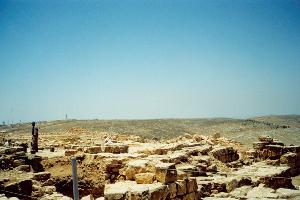 We trudge upward, our eyes on our feet, stepping over rocks and around thistles. The sun beats down unmercifully on our heads. Above us on the slope, a half-dozen manual laborers work around an archaeological dig. Beyond the workers, a bent and bearded Samaritan elder paces the ancient temple ruins which adorn the flat peak, curiously observing the half a hundred Americans ascending his Mount Gerizim. He permits our access, although he seems not to fully trust our intentions.
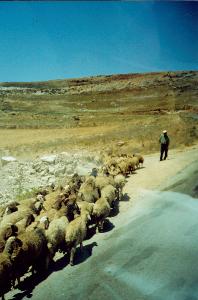 A million Samaritans populated this area in Jesus’ day. Today, some 300 remain on this mountain. Perhaps 300-400 more live elsewhere in the Holy Land. For centuries, Jews have despised Samaritans, considering them a mixed race descended from Israelites and transplanted foreigners (Ezra 4:2, 10). The Samaritans claim to be descendants of Israelites who were never taken to Assyria, or who returned from Assyrian captivity after 55 years — a supposed event concerning which the Bible is totally silent. The “true” Torah text, say the Samaritans, identifies Mount Gerizim as God’s chosen place for worship. They built a temple here some 300 years before Christ, and Samaritan priests still offer animal sacrifices amidst the ruins. The Jewish Bible says that God selected Jerusalem as the temple site. Racially and religiously, Jewish-Samaritan animosities run deep.
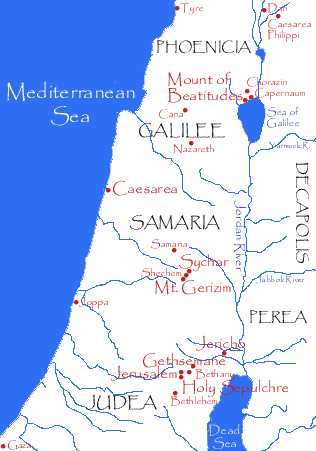 Very near this place, at Jacob’s Well at Sychar, Jesus ignored those animosities and defied rabbinic protocol by asking a Samaritan woman for a drink. Perceiving him to be a prophet — and perhaps to turn aside his penetrating personal questions about her own spiritual state — the woman tossed Jesus the theological issue. “Our fathers worshiped in this mountain; and you people say that in Jerusalem is the place where men ought to worship” (John 4:19-20). Surprisingly, Jesus did not take sides but rather transcended the controversy. “The true worshiper is not defined by such externals,” he replied in effect. The true worshiper is one who worships God “in spirit and in truth” (John 4:23-24). I look about our group, an interdenominational mix from North and South and West, theologically and culturally diverse, and I see a marvelous sight. Despite our differences, we are one in Christ, bound together by one Spirit, united in the truth that Jesus is God’s Son, the Jewish Messiah, our Savior and Lord. This is an appropriate location, I surmise, for us to remember that.